
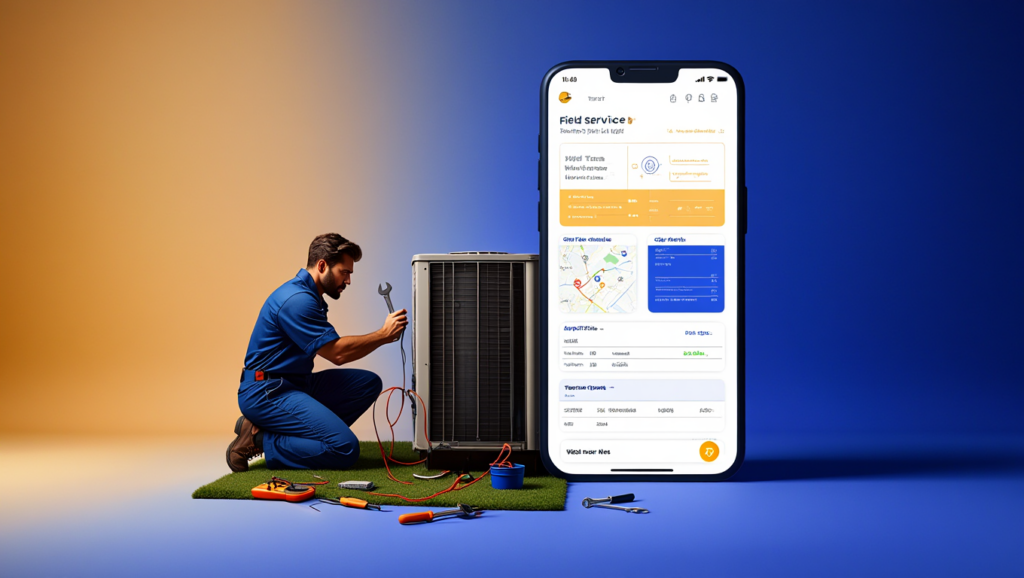
Your technicians are in the field eight to ten hours a day, and the tools they use on their phones directly affect how fast jobs get done, how accurate invoices are, and whether customers get a callback or a receipt. When a tech is standing in front of a customer trying to recall a part price, create an invoice, or update dispatch — a bad app doesn’t just slow them down, it costs you money and damages the customer experience.
Finding the best mobile app for field service technicians is one of the most searched decisions for growing service businesses, and the options have improved dramatically in 2026. The gap between a well-designed technician app and a mediocre one shows up in your Google reviews, your job cycle times, and how long it takes to onboard a new hire.
This article evaluates three of the most widely used field service apps — Jobber, Housecall Pro, and FieldEdge — across the criteria that matter to technicians and dispatch managers alike: how the app actually feels to use in the field, what it lets techs do without calling the office, and where each platform falls short. By the end, you’ll know which app fits your team, trade, and business size.
⚡ QUICK ANSWER
The best mobile app for field service technicians depends on your trade and team size. Housecall Pro is the top pick for small teams (1–10 techs) that want fast setup and built-in customer communication. Jobber is the best all-around field service technician app for businesses that need polished quoting, self-service client tools, and clean reporting. FieldEdge is the strongest choice for HVAC-specific operations that need flat-rate pricebooks and service agreement tracking in the field. All three offer iOS and Android apps with offline capability.
What to Look for in a Field Service Technician App
Not every technician app is built the same way. Some are glorified scheduling tools with a mobile skin. Others are full field service platforms where technicians can run an entire job start to finish without touching a desktop. Here’s what actually separates the good from the great.
Job Access and Real-Time Updates
A technician’s app needs to show job details — customer address, equipment history, scope of work, any notes from dispatch — the moment they open a work order. Real-time sync matters too: if a customer calls to add a scope item and the dispatcher updates the job, the tech should see that change on their phone immediately, not when they sync at the end of the day.
Quoting and Invoicing in the Field
The ability to build and send a quote or invoice on-site — while the customer is still there — is one of the highest-value features a technician app can offer. It eliminates the “I’ll send you a quote tomorrow” delay that kills conversion rates and shortens your payment cycle from weeks to hours. Look for apps that let techs add line items, apply discounts, and collect digital signatures and card payments without leaving the app.
Offline Functionality
Field technicians work in basements, mechanical rooms, rural properties, and commercial buildings with poor signal. An app that breaks when the internet does is a liability. The best field service apps cache job data locally and sync when connectivity is restored — so your tech can keep working regardless of signal strength.
Photo and Document Capture
Technicians document their work: before-and-after photos, equipment serial numbers, signed customer authorizations, permit paperwork. An app that makes this fast — tap to photo, attach to job, send to customer — reduces post-job admin time and protects you in the event of a warranty dispute or insurance claim.
GPS and Route Visibility
A technician app should show each tech where their next job is, how long it’ll take to get there, and ideally suggest the most efficient route across multiple stops. From the dispatch side, being able to see all technicians on a live map — with their current job status — eliminates the “where is everybody?” call.
Ease of Onboarding for Non-Technical Users
Your newest hire shouldn’t need a week of training to use the app. The best field service technician apps have simple, task-based mobile interfaces that guide techs through a job — check in, do the work, invoice, collect payment, move on. Complexity belongs in the desktop admin dashboard, not on the phone screen a tech is using with work gloves on.
Customer Communication Tools
The best apps let technicians communicate with customers directly through the platform — sending arrival time texts, sharing invoice links, collecting reviews — without using their personal phone numbers. This protects tech privacy and keeps all communication logged in the customer record.
The 3 Best Mobile Apps for Field Service Technicians in 2026
Now that you know what to look for, here’s how the three leading platforms stack up in real-world use.
1. Jobber — Best All-Around Field Service App for Growing Teams
Jobber’s mobile app is consistently rated as one of the most intuitive field service technician apps across trade industries — HVAC, plumbing, electrical, landscaping, pest control, and more. The app is available on iOS and Android and is designed around a simple job flow: clock in, do the work, invoice, collect payment, move to the next job.
Key features in the Jobber mobile app:
- Work order access — Technicians see their full schedule, job details, customer history, and any notes from dispatch the moment they open the app
- On-site quoting — Build line-item quotes, get customer approval via digital signature, and convert to an invoice instantly
- Invoice and payment collection — Techs can create and send invoices, collect credit card payments via Stripe, and mark jobs paid — all from their phone
- Photo and note capture — Attach photos, files, and job notes directly to the work order; everything syncs to the customer record in real time
- Two-way texting — Techs can send and receive texts through the Jobber platform using the company number, so personal cell numbers stay private
- GPS check-in — Technicians check in on arrival; dispatch sees a live map of all technicians and job statuses
- Offline mode — Job data is cached locally so techs can work without an internet connection and sync when signal returns
Pricing (verify on Jobber’s website — pricing as of 2026):
- Core: ~$49/month (1 user) — basic scheduling, invoicing, customer records
- Connect: ~$149/month (up to 5 users) — adds automation, two-way texting, QuickBooks Online sync, online booking
- Grow: ~$299/month (up to 15 users) — adds route optimization, job costing, Jobber Marketing, advanced reporting
A 14-day free trial is available on all plans without a credit card.
Best for: Field service businesses with 1–15 technicians across any trade — particularly those prioritizing quote conversion, clean customer communication, and fast technician onboarding. Jobber is also the strongest pick for multi-trade businesses (e.g., HVAC and plumbing) because it handles both without trade-specific workarounds.
One limitation: Jobber doesn’t have a built-in flat-rate pricebook. Technicians build line items from scratch or from a customizable product/service list, but there’s no pre-loaded HVAC or plumbing catalog the way FieldEdge offers. For businesses where flat-rate field quoting is central to operations, this is a real gap.
Start your free 14-day trial of Jobber here — no credit card required.
2. Housecall Pro — Best App for Small Teams That Want Fast Setup
Housecall Pro is the most widely used field service platform for small residential service businesses, and its mobile app reflects that focus: it’s built to be fast, friendly, and functional with minimal configuration. If you have 1–10 technicians and want your team using a mobile app within a day or two of signing up, Housecall Pro is the easiest on-ramp in this category.
Key features in the Housecall Pro mobile app:
- Job card interface — Each job is presented as a clean card with customer info, address, service details, and arrival window — easy to scan between stops
- On-site invoicing — Create invoices, apply discounts or coupons, and collect payment by card, check, or cash directly in the app
- Review request automation — After a job is marked complete, the app can automatically trigger a review request text to the customer — no manual action required from the tech
- Real-time notifications — Techs get push notifications for new job assignments, schedule changes, and customer messages
- Photo documentation — Attach before-and-after photos to any job; they’re stored in the customer record and can be included in invoices or follow-up emails
- GPS tracking — Dispatchers see technician locations on a live map; customers receive an Uber-style “on the way” notification with the tech’s ETA
- Integrated customer financing — Housecall Pro has a built-in consumer financing option (via Wisetack) that techs can offer customers on large-ticket jobs without leaving the app
Pricing (verify on Housecall Pro’s website — pricing as of 2026):
- Basic: ~$49/month (1 user) — scheduling, invoicing, payments
- Essentials: ~$129/month (up to 5 users) — adds automation, two-way texting, review management
- Grow: ~$279/month (up to 8 users) — adds marketing tools, postcard campaigns, reporting
- Max/Enterprise: Custom pricing for larger teams
Best for: Small residential HVAC, plumbing, electrical, and home services businesses (1–8 technicians) that want the fastest possible setup and genuinely useful automation without deep configuration. The built-in review automation alone makes Housecall Pro worth evaluating for any business trying to build their Google review count.
One limitation: Housecall Pro’s automation builder is less flexible than Jobber’s, and the platform doesn’t scale as cleanly past 10–12 technicians. Businesses that grow quickly often find themselves hitting plan ceilings or needing features (like advanced job costing or service agreement tracking) that Housecall Pro doesn’t offer at the depth they need.
See Housecall Pro’s current pricing and plans here
3. FieldEdge — Best App for HVAC-Specific Field Operations
FieldEdge’s mobile app is built for HVAC, plumbing, and electrical technicians who need trade-specific functionality that general field service apps can’t replicate. Where Jobber and Housecall Pro are horizontal platforms (built to work across many trades), FieldEdge is a vertical platform — designed specifically for the operational realities of HVAC service businesses.
Key features in the FieldEdge mobile app:
- Flat-rate pricebook access — Technicians open the app and pull from a pre-built, customizable flat-rate catalog. They can price a repair on-site in 30 seconds without calling the office for approval or looking up parts manually
- Equipment history by location — When a tech arrives at a job, the app shows every piece of equipment at that address — model numbers, serial numbers, installation dates, and the full service history. This eliminates the “I don’t know what was done last time” problem entirely
- Service agreement visibility — Techs can see whether a customer has an active maintenance agreement, what it covers, and when it expires — directly in the job card
- On-site invoicing and payment — Create invoices from the flat-rate catalog, collect signatures, and process card payments in the field
- Real-time dispatch sync — Job assignments, schedule changes, and customer notes sync in real time between the dispatch board and the technician’s app
- Photo capture and notes — Attach photos and technician notes to any job; they’re stored in the customer record and visible to dispatch immediately
Pricing (verify directly with FieldEdge — pricing as of 2026):
FieldEdge does not publish pricing publicly. Based on documented user reports, expect approximately $125–$300+ per user per month depending on team size and selected modules. An implementation fee applies. You’ll need to request a demo and custom quote directly from FieldEdge’s sales team.
Best for: Established HVAC companies (5–30+ technicians) where flat-rate pricing, service agreements, and equipment history are central to daily operations. FieldEdge is also the right choice for businesses running QuickBooks Desktop — its two-way sync with both QuickBooks Desktop and QuickBooks Online is more robust than either Jobber or Housecall Pro offer.
One limitation: FieldEdge’s mobile app has a steeper learning curve than Jobber or Housecall Pro. The depth of features — particularly the flat-rate pricebook and equipment tracking — requires structured onboarding. Technicians typically need 2–3 weeks to work through the app comfortably, compared to a few days for the other two platforms.
Comparison Table: Jobber vs Housecall Pro vs FieldEdge Mobile Apps
| Feature | Jobber | Housecall Pro | FieldEdge |
|---|---|---|---|
| Mobile App | ✅ | ✅ | ✅ |
| Offline Mode | ✅ | ✅ | ✅ |
| On-site Quoting | ✅ | ✅ | ✅ |
| On-site Invoicing | ✅ | ✅ | ✅ |
| Card Payments | ✅ | ✅ | ✅ |
| Pricebook | ❌ | ❌ | ✅ |
| Equipment Tracking | ⚠️ Basic | ⚠️ Basic | ✅ Full |
| Service Agreements | ⚠️ Limited | ❌ | ✅ Full |
| GPS Tracking | ✅ | ✅ | ✅ |
| Route Optimization | ✅ (Grow) | ✅ | ✅ |
| Two-way Texting | ✅ (Connect+) | ✅ | ⚠️ Limited |
| Review Automation | ✅ | ✅ | ❌ |
| Customer Financing | ❌ | ✅ | ❌ |
| QB Online Sync | ✅ | ✅ | ✅ |
| QB Desktop Sync | ❌ | ❌ | ✅ |
| Multi-Trade | ✅ | ✅ | ⚠️ Limited |
| Pricing Transparency | ✅ | ✅ | ❌ |
| Starting Price | $49/month | $49/month | ~$125+/user |
| Free Trial | 14 days | 14 days | Demo only |
| Best Team Size | 1–15 | 1–10 | 5–30+ |
| Ease of Use | ⭐⭐⭐⭐⭐ | ⭐⭐⭐⭐⭐ | ⭐⭐⭐ |
Jobber
Housecall Pro
FieldEdge
Conversion Positioning
- Best Overall: Jobber – strongest balance of usability, features, and pricing
- Best Budget: Jobber / Housecall Pro – affordable entry with solid mobile tools
- Best for Growth: FieldEdge – advanced features for scaling HVAC teams
- Best for Payments & Automation: Housecall Pro – built-in financing and strong automation
Our Top Pick and Why
For most field service businesses reading this, Jobber is the strongest all-around mobile app for field service technicians in 2026. It hits the right balance of features, usability, and price across the widest range of trades and team sizes. The mobile app is fast and intuitive — a new technician can navigate a full job cycle on their first day. The quoting and payment tools are genuinely best-in-class. The Client Hub reduces inbound calls. And the pricing is transparent, so you know what you’re paying before you commit.
That said, the right answer changes based on your situation:
- If you’re a small residential shop and want to be live within 48 hours, Housecall Pro’s onboarding speed and built-in review automation give it the edge.
- If HVAC is your trade, you have 8+ technicians, and flat-rate field pricing is how you operate, FieldEdge is worth the higher price and longer setup time — the depth pays off.
How to Schedule Field Technicians Without Spreadsheets in 2026
If Jobber fits your team, start a free 14-day trial here — your technicians can be using the app by tomorrow.
Deducting Your Field Service App as a Business Expense
All three platforms — Jobber, Housecall Pro, and FieldEdge — are software subscriptions used exclusively for business operations, which means they qualify as fully deductible ordinary business expenses under IRS guidelines. [EXTERNAL LINK: IRS business expense deductions → IRS.gov Publication 535] A 5-technician team on Jobber’s Grow plan pays roughly $3,600/year — all of it deductible. FieldEdge’s higher per-user pricing means even larger deductions at scale. Factor this into your cost comparison: the real after-tax cost of any of these platforms is meaningfully lower than the listed price. Consult your accountant for specifics, but software subscriptions for business use are generally expensed in the year paid, not depreciated over time.
Frequently Asked Questions
What is the best mobile app for field service technicians in 2026?
The best mobile app for field service technicians depends on trade and team size. Jobber is the top all-around pick for service businesses across trades — particularly for companies with 1–15 technicians that need clean quoting, dispatch visibility, and customer communication tools. Housecall Pro is the easiest to set up for small residential teams. FieldEdge is the strongest choice for established HVAC businesses that need flat-rate pricebooks and full service agreement tracking in the field. All three offer iOS and Android apps with offline mode, on-site invoicing, and card payment collection.
Can field service technicians create invoices from their phone?
Yes — all three apps covered in this article (Jobber, Housecall Pro, and FieldEdge) let technicians create, send, and collect payment on invoices directly from their mobile device. Technicians can add line items, apply discounts, collect a digital signature, and process a credit card — all without returning to the office or involving a dispatcher. This on-site invoicing capability is one of the most impactful features for reducing payment cycle times and eliminating end-of-day paperwork.
Does Jobber have a mobile app for technicians?
Yes — Jobber’s mobile app is available on both iOS and Android and is one of the highest-rated field service technician apps in its category. Technicians use it to view their schedule, access job details and customer history, build and send quotes, invoice customers, collect payments, attach photos, and send two-way texts through the company’s Jobber number. The app works offline and syncs when connectivity is restored. Most technicians report being comfortable with the full job flow within their first day of use.
How does a field service scheduling app improve technician efficiency?
A field service scheduling app improves technician efficiency in three main ways. First, it eliminates the “office call” — techs access job details, customer notes, equipment history, and pricing directly from their phone without calling dispatch. Second, it accelerates the quote-to-payment cycle — on-site invoicing and card collection mean no chasing payments a week later. Third, GPS check-ins and route optimization reduce drive time between jobs. Studies cited by field service platforms consistently show technicians complete 1–2 more jobs per day when using a well-designed mobile app versus paper-based or phone-based workflows.
What field service app works best for HVAC technicians specifically?
For HVAC technicians specifically, FieldEdge offers the most trade-relevant features: a flat-rate pricebook technicians can access on-site, equipment history tied to customer locations, and service agreement visibility directly in the job card. These are features that general field service apps like Jobber and Housecall Pro don’t fully replicate. However, FieldEdge’s higher cost and longer onboarding make it most appropriate for established HVAC companies with 5 or more technicians. Smaller HVAC shops often get more value from Jobber or Housecall Pro, particularly in the early growth phase.
Do these apps work without an internet connection?
Yes — Jobber, Housecall Pro, and FieldEdge all offer offline functionality. Job data is cached locally on the device when there’s a connection, so technicians can view job details, add notes, attach photos, and create invoices even without signal. Everything syncs automatically when connectivity is restored. This is essential for service businesses that send technicians to basements, rural areas, commercial buildings, or any location with unreliable cell service. Before committing to any field service technician app, test the offline mode specifically in the types of locations your technicians work most often.
The Bottom Line
The mobile app your technicians carry is the front line of your entire service operation — it’s how jobs get executed, invoices get sent, and customers form their impression of your business. Picking a slow, confusing, or feature-thin app doesn’t just frustrate your team; it actively limits how many jobs they can complete and how professional the customer experience feels.
For most field service businesses in 2026, Jobber offers the best combination of mobile functionality, ease of use, and value — across HVAC, plumbing, electrical, and beyond. If you want your technicians using a powerful, intuitive mobile app starting this week, start a free 14-day trial of Jobber here— no credit card, no sales call required.