
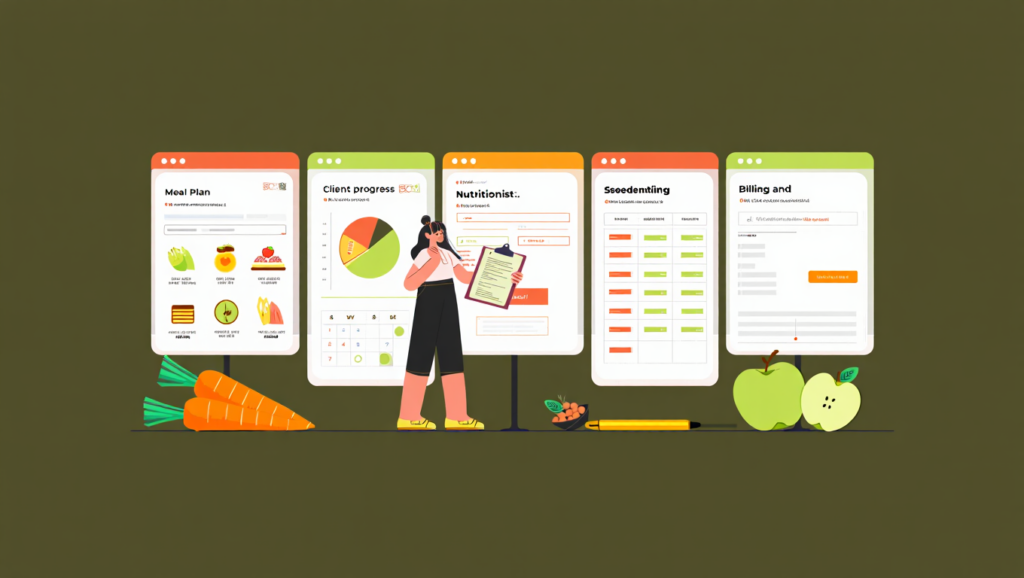
You’re running a nutrition practice with 20+ active clients. Every week you juggle separate spreadsheets for intake forms, Google Docs for meal plans, WhatsApp for check-ins, PayPal for billing, and a calendar that lives somewhere else entirely. That patchwork system costs you at least 5–10 hours per week in manual work — time you could spend with clients or growing your business.
This is the reality for most solo dietitians and health coaches. And it’s why nutrition practice management software exists. These all-in-one platforms combine client intake, meal planning, progress tracking, telehealth, billing, and automation under one roof.
In this nutrition practice management software comparison, I’ll break down five leading tools — Practice Better, NutriCRM, Nutrena, Halaxy, and Zanda Health — across pricing, features, ease of use, and real-world limitations. By the end, you’ll know exactly which platform fits your practice size, niche, and budget.
⚡ QUICK ANSWER
For most solo dietitians and nutrition coaches, Practice Better offers the best balance of meal planning tools, client engagement features, and automation. NutriCRM is stronger for high-volume clinical practices needing robust reporting. Halaxy wins on price with a solid free plan. Your best choice depends on whether you prioritize meal planning (Practice Better), clinical workflow (NutriCRM), or budget (Halaxy).
What to Look for in Nutrition Practice Management Software
Before diving into individual reviews, let’s establish the criteria that actually matter when you’re running a nutrition business. These are the features that separate a usable platform from a frustrating one.
Meal planning and food logging – Can clients log meals inside the platform? Can you build custom meal plans with recipes, portion sizes, and grocery lists? This is the core differentiator between general practice management software and nutrition-specific tools.
Client portal and communication – Look for a branded client portal where clients can complete intake forms, message you securely, view documents, and schedule appointments. Avoid tools that rely on external email chains.
Telehealth integration – Built-in video sessions with screen sharing and whiteboard features eliminate the need for separate Zoom or Google Meet accounts. Many clients now expect this as standard.
Automation and reminders – Automated appointment reminders (SMS/email), follow-up messages, and billing saves you hours each week. The best platforms let you create custom automation sequences.
Billing and payments – Can you charge clients directly, store cards on file, and process recurring subscriptions? Some platforms charge transaction fees; others integrate with Stripe or PayPal.
Reporting and progress tracking – Look for customizable client dashboards that show weight, body measurements, lab results, or habit tracking over time. Clinical practices need exportable reports.
Ease of use and onboarding – You don’t want to spend weeks learning software. Check if they offer live onboarding calls, knowledge bases, or free training.
Pricing transparency – Watch for hidden per-client fees or long-term contracts. Most platforms charge a flat monthly fee plus optional add-ons.
The 5 Best Nutrition Practice Management Software for 2026
1. Practice Better – Best overall for solo practitioners and small clinics
Practice Better is the most popular nutrition practice management platform for a reason. It’s built specifically for dietitians, nutritionists, and health coaches — not repurposed for them. The platform handles everything from client intake to meal planning to group programs.
Key features:
- Drag-and-drop meal planner with 1,000+ recipe database and grocery list generator
- Customizable client portal with secure messaging and file sharing
- Built-in telehealth with screen sharing and recording
- Automated workflows for reminders, follow-ups, and recurring billing
- Group programs and course creation (for running challenges or group coaching)
- Mobile app for clients (iOS and Android)
Pricing (as of 2026):
- Essentials: $29/month – 10 active clients, basic forms, calendar, messaging
- Plus: $49/month – 50 active clients, meal planning, telehealth, automation
- Pro: $79/month – 200 active clients, group programs, advanced reports, API access
- Enterprise: custom pricing
All plans include a 14-day free trial. No setup fees or contracts.
Best for: Solo practitioners and small clinics (2–5 providers) who want robust meal planning and client engagement tools without complex setup.
Limitations: The Essentials plan caps at 10 active clients, which is too low for most full-time practitioners. The mobile app for practitioners is less polished than the web version. Reporting is solid but not as deep as NutriCRM’s clinical analytics.
Start your free 14-day trial here]
2. NutriCRM – Best for clinical and high-volume practices
NutriCRM takes a different approach. Instead of focusing on meal planning aesthetics, it prioritizes clinical data management, reporting, and scalability. If you run a practice with multiple dietitians or need detailed outcome tracking for insurance or research, this is your tool.
Key features:
- Advanced client charting with customizable SOAP notes and assessment templates
- Body composition and lab value tracking over time with graphical trends
- Meal planning with nutrient analysis (supports 20+ micronutrients)
- Billing and insurance claim management (US-specific)
- Multi-provider scheduling with resource allocation
- API and white-label options for larger organizations
Pricing (as of 2026):
- Solo: $25/month – 1 practitioner, 100 clients, basic forms, meal planning
- Group: $45/month – 2-5 practitioners, 500 clients, advanced reporting, insurance billing
- Clinic: $75/month – 6-10 practitioners, unlimited clients, API access
- Enterprise: custom
Plans include a 30-day free trial.
Best for: Clinical nutrition practices, hospitals, and wellness clinics that need detailed patient records, lab integration, and insurance billing. Also good for dietitians who bill insurance directly.
Limitations: The interface feels more clinical than modern — it’s functional but not beautiful. Meal planning lacks the visual drag-and-drop polish of Practice Better. The learning curve is steeper, especially for solo practitioners without admin support.
Try NutriCRM free for 30 days]
3. Nutrena – Best for solo coaches focused on habit change
Nutrena is the newest platform on this list, built specifically for health coaches and nutritionists who emphasize habit tracking and client accountability over clinical documentation. It’s lightweight, affordable, and surprisingly powerful for its price.
Key features:
- Habit tracking with custom metrics (water intake, steps, sleep, mood)
- Weekly check-in forms with automated summaries
- Meal planning with “swap lists” (instead of rigid plans)
- Client dashboard with progress photos and goal tracking
- Automated messaging sequences for onboarding and offboarding
- Stripe integration for one-time and subscription payments
Pricing (as of 2026):
- Starter: $19/month – up to 30 active clients, basic habits, forms
- Pro: $39/month – up to 100 clients, advanced automation, meal planning, progress photos
- Business: $69/month – unlimited clients, team accounts, API
14-day free trial on all plans.
Best for: Solo health coaches, weight loss specialists, and nutritionists who focus on behavioral change rather than clinical data. Also great for coaches just starting out who want an affordable entry point.
Limitations: No telehealth built-in (you’ll need a separate Zoom or Google Meet link). Client portal is functional but less polished than Practice Better. Lacks insurance billing and advanced clinical reporting.
4. Halaxy – Best free plan for budget-conscious practitioners
Halaxy is an Australian-born practice management platform that has expanded globally. It’s not nutrition-specific — it serves allied health (physio, psych, chiro) — but it includes enough nutrition features to work well for dietitians, especially those on a tight budget.
Key features:
- Comprehensive calendar with waitlist management and online bookings
- Telehealth with screen sharing and waiting room
- Customizable clinical notes and templates (including SOAP)
- Automated appointment reminders (SMS costs extra)
- Invoicing, payment processing, and Xero integration
- Client portal with intake forms and document storage
Pricing (as of 2026):
- Free: $0/month – 5 active clients, basic calendar, manual notes, no telehealth
- Premium: $30/month – unlimited clients, telehealth, reminders, online bookings
- Premium Plus: $45/month – advanced reporting, SMS credits, multi-location
Free plan includes 2GB storage and email support. Premium plans have a 14-day free trial.
Best for: Solo practitioners who want to start for free and scale later. Also good for practitioners outside the US who don’t need insurance billing or nutrition-specific meal planning.
Limitations: The free plan is very limited (5 active clients is a teaser, not a real practice). Meal planning is non-existent — you’ll need to attach PDFs or use another tool. The interface feels dated and can be sluggish. Customer support response times have been criticized on Reddit and Trustpilot.
5. Zanda Health – Best for telehealth-first nutritionists
Zanda Health (formerly Power Diary) rebranded and rebuilt its platform with a focus on telehealth and automation. Like Halaxy, it serves multiple allied health professions, but its modern interface and strong API make it a contender for tech-savvy dietitians.
Key features:
- Slick calendar with drag-and-drop rescheduling and color coding
- Built-in telehealth with waiting room and session recording
- Automated SMS/email reminders (SMS has per-message fee)
- Client management with custom data fields and tags
- Online store for selling packages, courses, or meal plans
- Two-way calendar sync with Google and iCal
Pricing (as of 2026):
- Starter: $25/month – up to 50 active clients, calendar, forms, basic automation
- Standard: $39/month – up to 200 clients, telehealth, online store, API
- Premium: $59/month – unlimited clients, advanced reports, priority support
All plans include a 14-day free trial. No per-client fees.
Best for: Telehealth-focused dietitians who want a modern, fast interface. Also good for practitioners who sell digital products (meal plans, courses) directly through their practice software.
Limitations: No built-in meal planning or food logging. You can attach meal plan PDFs, but you can’t build interactive plans. The platform is generalist — it lacks nutrition-specific features like nutrient analysis or recipe databases.
Comparison Table: Nutrition Practice Management Software
| Criteria | Practice Better | NutriCRM | Nutrena | Halaxy | Zanda Health |
|---|---|---|---|---|---|
| Starting Price | $29 | $25 | $19 | $0 / $30 | $25 |
| Free Trial | 14 days | 30 days | 14 days | 14 days | 14 days |
| Meal Planning | Drag & drop | Nutrient analysis | Basic | No | No |
| Telehealth | Plus plan+ | All plans | No | Premium | Standard+ |
| Client Portal | Branded | Branded | Basic | Branded | Branded |
| Reminders | SMS extra | Email + SMS | SMS extra | SMS extra | |
| Insurance Billing | No | Yes (US) | No | No | No |
| Best For | Small clinics | High-volume | Solo coaches | Budget starters | Telehealth-first |
Practice Better
NutriCRM
Nutrena
Halaxy
Zanda Health
Our Top Pick and Why
For the vast majority of dietitians and nutrition coaches, Practice Better is the clear winner in this nutrition practice management software comparison.
Why? Because it’s the only platform that nails all three core needs: meal planning, client communication, and automation — without forcing you to compromise. NutriCRM has better clinical reporting but weaker meal planning. Nutrena is cheaper but lacks telehealth. Halaxy and Zanda are generalist tools missing nutrition-specific features.
Practice Better’s drag-and-drop meal planner saves you hours compared to building plans in Google Docs. Its automated workflows handle reminders and follow-ups. And the 14-day free trial (no credit card required) lets you test everything.
Practice Better – Claim your 14-day free trial here]
If you run a clinical practice billing insurance, choose NutriCRM. If you’re on a tight budget, start with Halaxy’s free plan. But for most practitioners, Practice Better delivers the best ROI.
Tax Deduction for Nutrition Practice Software (Section 179)
Here’s something many solo practitioners miss: nutrition practice management software is 100% tax-deductible as a business operating expense in the US under Section 179. The same applies in Canada, the UK, and Australia as a standard business expense. That $29–$79 monthly subscription effectively costs 20–40% less after taxes, depending on your bracket. Keep your receipts and invoices — and talk to your accountant. This also applies to telehealth equipment, webcams, and even portions of your home internet if you work from a dedicated home office.
Frequently Asked Questions
What is the best nutrition practice management software for solo dietitians?
Practice Better is widely considered the best for solo dietitians because it combines meal planning, telehealth, client messaging, and automation in one platform. The Plus plan ($49/month) supports up to 50 active clients, which covers most full-time solo practices. Nutrena is a strong budget alternative at $19/month but lacks built-in telehealth.
Can I use general practice management software instead of nutrition-specific tools?
Yes, but you’ll lose nutrition-specific features like meal planning, food logging, nutrient analysis, and progress tracking for weight or lab values. General tools like Halaxy or Zanda Health work for scheduling and billing, but you’ll need separate software for meal plans. For most nutrition professionals, the time savings of an all-in-one platform justify the cost.
How much does nutrition practice management software cost on average?
Most platforms range from $25 to $50 per month for a solo practitioner with 50–100 active clients. Practice Better starts at $29, NutriCRM at $25, Nutrena at $19, and Halaxy’s paid plan at $30. Free plans exist but typically cap active clients at 5–10 — fine for testing, not for a real practice.
Does this software integrate with electronic health records (EHR) systems?
Practice Better and NutriCRM offer API access on higher-tier plans, allowing integration with external EHRs. NutriCRM also includes built-in SOAP notes and clinical charting that function like an EHR. Halaxy and Zanda Health are themselves considered lightweight EHRs for allied health. If you need full EHR compliance (e.g., HIPAA in the US), all five platforms are HIPAA-compliant with signed BAAs.
Which platform has the best meal planning features?
Practice Better has the most intuitive meal planning with a drag-and-drop interface, recipe database, and grocery list generator. NutriCRM offers deeper nutrient analysis (20+ micronutrients) but a less visual interface. Nutrena provides “swap lists” for flexible meal planning. Avoid Halaxy and Zanda if meal planning is a priority — they don’t offer it natively.
Is there nutrition practice management software with a free plan that actually works?
Halaxy’s free plan supports up to 5 active clients with basic calendar and manual notes — useful for testing or seeing 1–2 pro bono clients. But for a real practice, you’ll outgrow it immediately. No other major nutrition platform offers a truly usable free tier. Instead, look for 14–30 day free trials (all five tools offer them) and budget $30–50/month as a standard business expense.
Conclusion
Switching from a messy patchwork of spreadsheets, PDFs, and separate apps to dedicated nutrition practice management software will save you at least 5–10 hours per week. That’s time you can reinvest into client care, marketing, or simply having a life outside your practice.
For most solo dietitians and health coaches, Practice Better offers the best combination of meal planning, automation, and ease of use. It’s the tool I’d recommend to a friend starting a practice today. If you run a clinical practice billing insurance, go with NutriCRM. If budget is your primary constraint, start with Halaxy’s free plan and upgrade later.
Best Patient Communication Software for Small Clinics (HIPAA-Compliant Tools for 2026)
How to Go Paperless in a Small Medical Practice (Step-by-Step Guide for 2026)
Best EMR for Cash-Pay Chiropractic Practices (Simple & Affordable Options for 2026)
[read: Small business software tax deduction rules (IRS Section 179) → IRS.gov]
Ready to stop juggling spreadsheets? Start your free 14-day trial of Practice Better — no credit card required, and you can cancel anytime.
Practice Better – Start free trial